
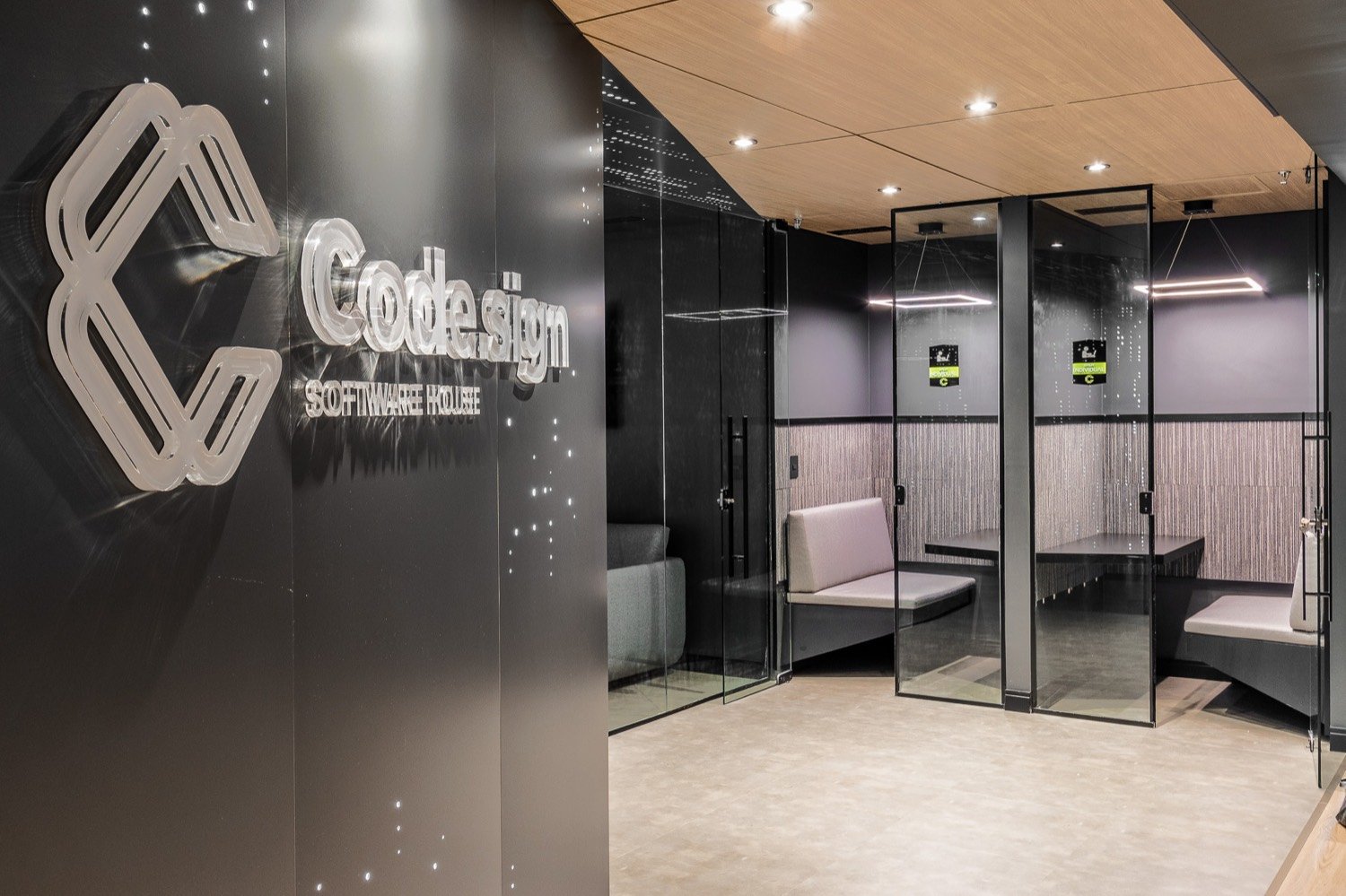
Space is the most honest communicator a brand has.
Every company invests in branding. They hire agencies to sharpen their positioning, refine their voice, perfect their logo. Then they put all of it inside a generic office — standard furniture, neutral colors, no identity. Yet the physical space is the most visceral touchpoint a brand has. Employees live inside it for hours a day. Clients and partners form impressions in seconds. Candidates decide whether they want to work there before the interview is even over. Unlike an ad or a social post, the space doesn't lie.
When the environment speaks for the brand
Spatial branding is the discipline of turning the built environment into a tangible extension of brand identity. It goes far beyond painting walls in the logo's colors or sticking value statements on the glass. It builds a complete sensory experience that tells you, intuitively, who the company is — through the texture of materials, the way light enters, the rhythm of the space, whether it's fluid or segmented, open or intimate. Every element communicates. The Meta project was exactly this challenge: to materialize culture in space, so that anyone walking in would immediately feel what the company stands for.
The three levels of spatial branding
First level — visual. The brand's identity applied to space: colors, logos, typography. Necessary, but not enough.
Second level — behavioral. The space induces behaviors that reflect the brand's culture. Companies that value collaboration have spaces that naturally create encounters; companies that prize innovation have environments that invite experimentation. It doesn't happen by accident — it's designed.
Third level — emotional, the most powerful. The space produces an almost unconscious, visceral response: the sense of belonging that makes someone turn down a better-paid offer to stay; the pride that makes an employee want to show the office to friends and family. When all three levels align, the office doesn't need a sign to say who it is. The space already said it.
The "Frankenstein office"
The opposite of spatial branding is the Frankenstein office: a patchwork of isolated decisions made by different people at different times, with no unifying strategy. One floor designed by one firm, the expansion by another. A break room redone because someone saw something on Pinterest. The CEO's office decorated by an interior studio that never spoke to whoever did the rest. The result communicates disorganization and fragmentation — and if the space looks confused, the message employees, clients, and candidates receive is that the company is confused.
If someone walked into your office not knowing the company's name, could they guess who you are? Would they feel the culture? Understand the values?
If the answer is no, the space is silent. Or worse — it's telling the wrong story.