
It's not a lack of motivation. It's the brain reacting to its environment.
The human brain wasn't built for the conventional open office. It doesn't process complex information through a wall of simultaneous conversations. It doesn't function well under hours of fluorescent light. And it doesn't produce its best ideas inside a monotonous routine. That isn't an opinion — it's neuroscience.
What your office is doing to your team's brain
The prefrontal cortex — responsible for concentration, decision-making, and strategic thinking — is extraordinarily sensitive to its surroundings. Excess noise measurably reduces the capacity to focus. Too much artificial light disrupts cortisol cycles. The absence of natural elements — daylight, greenery, organic textures — raises stress levels. A poorly designed office isn't neutral. It actively degrades people's cognitive performance, every day, without anyone noticing.
Focus and decompression aren't a luxury — they're biology
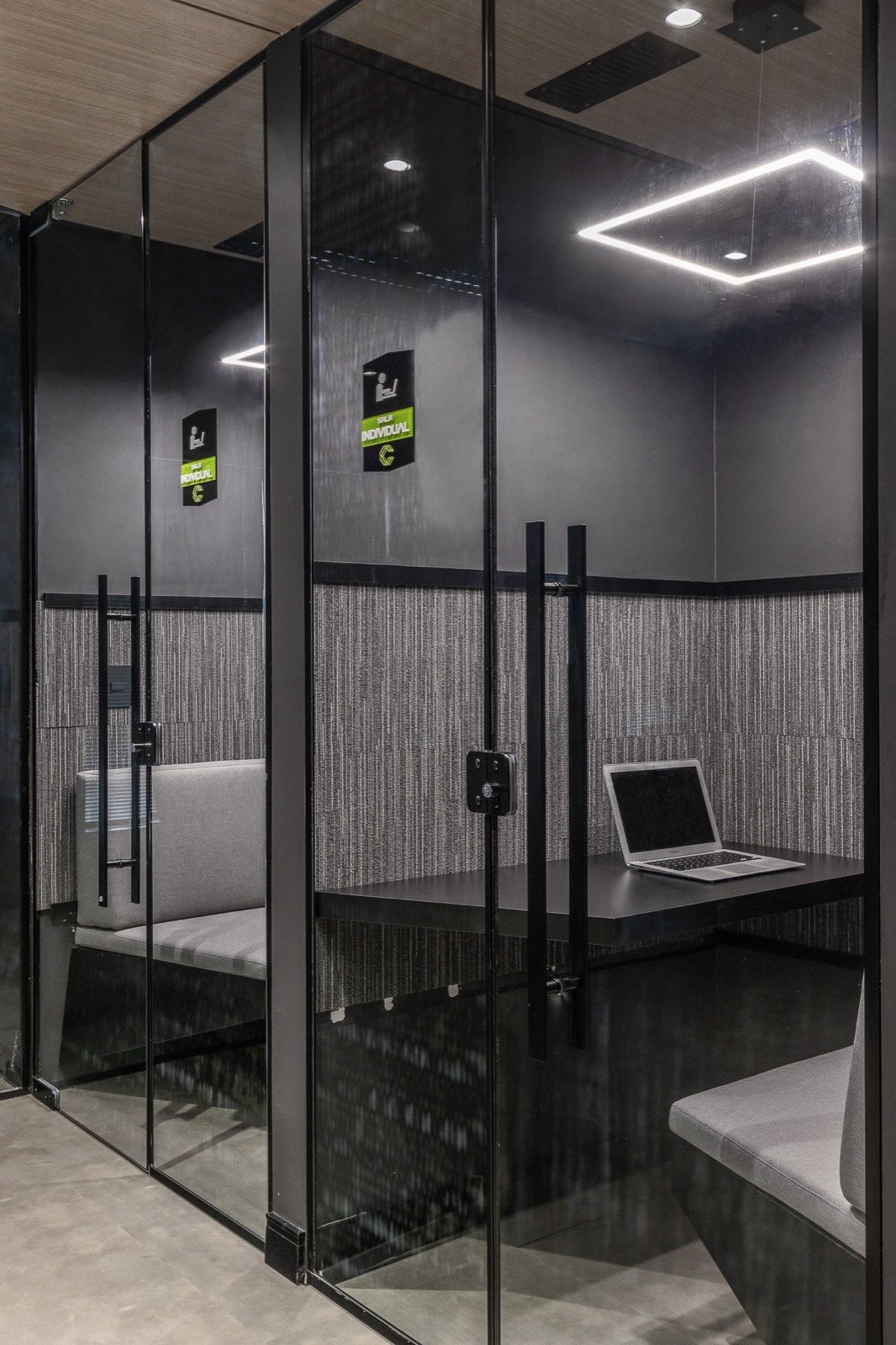
On the CODESIGN project, the diagnosis surfaced something simple but transformative: the team needed focus and decompression zones — not as a perk, but as a functional requirement of the brain. The brain naturally alternates between two modes: focused (concentrated attention, problem-solving) and diffuse (creative wandering, connecting ideas). An office that offers only one kind of environment blocks half of its people's cognitive capacity.
It's like owning a sports car and only being allowed to use first gear.
Why this matters for your business
Every hour lost to broken concentration has a measurable cost. Every idea that never forms is a missed opportunity. Every resignation can be, in part, an environmental failure. Neuroarchitecture turns invisible variables into concrete design decisions: ceiling heights that favor creativity, lighting that supports deep focus, textures and colors that lower stress, layouts that shape spontaneous interaction. The measurable result: higher productivity, better well-being indicators, lower absenteeism.
The hallway test
Walk through your office at 2 p.m. on a Tuesday. Notice who's wearing headphones just to wall off the noise. Count how many left for a café or coworking space because "they get more done there." Watch the calls being taken in improvised corners. What you're seeing isn't laziness or a pampered generation. It's the human brain telling you the space doesn't work.
The real question isn't whether your team is good enough. It's whether your space is good enough for your team.